When Should Married Couples Claim Social Security?

Social Security may be the only government program that requires a small amount of detective work just to figure out how it applies to you. The biggest question we get from couples is When should we claim Social Security?
For couples retiring in Burleson and the greater Fort Worth area, this decision often intersects with other local factors, including property tax exemptions, cost of living, and how Social Security timing fits into a broader retirement income plan. Getting the claiming strategy right is one of the highest-leverage decisions a couple can make before retiring.
Why the Higher Earner's Decision Matters Most
This lasting impact comes down to how survivor benefits work. When one spouse passes away, the surviving spouse typically receives the larger of the two Social Security checks. The smaller benefit generally ends with the deceased spouse.
This means the benefit amount the surviving spouse receives depends heavily on the higher earner's claiming decision. Simply put, the larger benefit becomes the survivor's monthly income for as long as they live.
The Cost of Claiming Early vs. Waiting
To put this into perspective, consider the potential increase in benefits when the higher earner delays claiming:
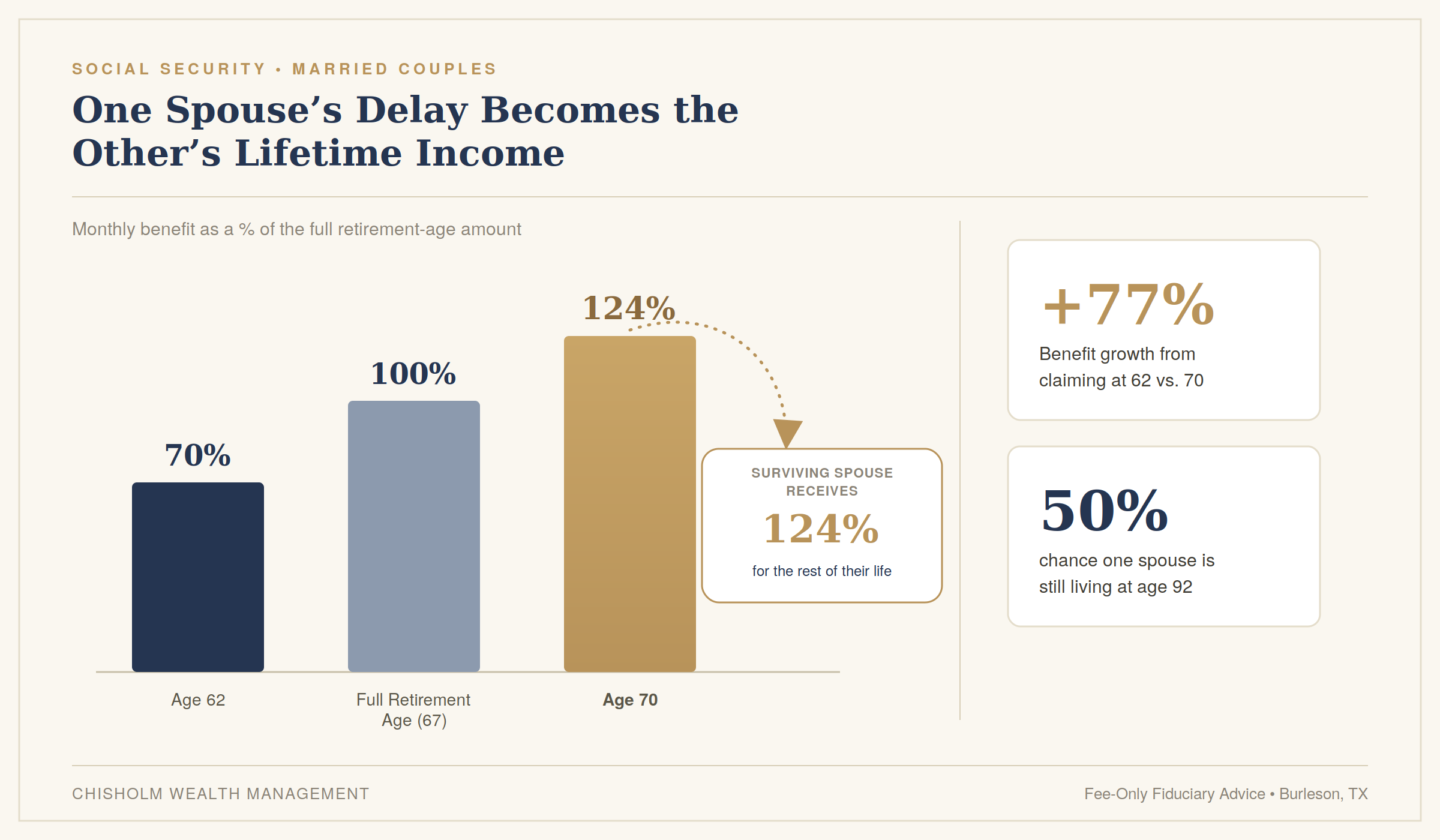
If the higher-earning spouse waits from age 62 to 70 to start claiming, their monthly benefit can increase by roughly 77%. Since the survivor receives the larger benefit, this delay doesn't just increase the higher earner's monthly income. It also boosts the survivor's future benefit by that same amount.
In other words, the decision to delay claiming isn't just about maximizing income during one lifetime; it's a choice that impacts two lifetimes. Statistically, at least one spouse in a healthy couple retiring at age 65 is likely to live well into their 90s, with about a 50% chance that one spouse will still be alive at age 92. This makes the survivor benefit a critical part of the claiming strategy.
Think of It as a Household Decision, Not Two Separate Choices
Because of this, it's important for couples to think of Social Security claiming as a household decision rather than two separate individual choices. Often, the best approach involves:
The lower earner claiming benefits earlier, perhaps as soon as they're eligible, to help with cash flow in the early retirement years
The higher earner waiting, allowing their benefit to grow to a larger amount
This strategy helps ensure the highest possible survivor benefit, which can provide greater financial security for the spouse who lives longer.
Every Couple's Situation Is Different
Of course, every couple's situation is unique. Factors such as current income needs, health status, life expectancy, and other sources of retirement income (including 401(k) catch-up contributions) all play a role in determining the best claiming strategy.
For instance, if the lower earner has health concerns that might limit their lifespan, it could make sense to claim earlier. Conversely, if the higher earner is in excellent health and expects to live well beyond average life expectancy, delaying benefits could be especially advantageous.
Running the numbers is key. Many couples benefit from modeling different claiming scenarios (including spousal benefits, but that’s another article in and of itself) to see how they affect lifetime income, including survivor benefits. This helps avoid decisions based on guesswork or misinformation. A thoughtful analysis can reveal the impact of claiming age combinations and help couples find a balance between immediate income needs and long-term financial security.
Frequently Asked Questions
Should the lower-earning spouse claim Social Security early? Often, yes. Claiming early provides cash flow in the early retirement years while the higher earner delays claiming to grow the benefit that will eventually become the survivor benefit.
How much does delaying Social Security from age 62 to 70 increase benefits? Delaying from 62 to 70 can increase the higher earner's monthly benefit by roughly 77%, since benefits grow both from reaching full retirement age and from delayed retirement credits after that.
What happens to Social Security when a spouse dies? The surviving spouse receives the larger of the two benefits; the smaller benefit ends. This is why the higher earner's claiming age has such a lasting impact on household income.
The Bottom Line
Social Security is a significant part of many couples' retirement plans, and the claiming strategy you choose can either enhance or limit your financial options in retirement and beyond.
Considering it as a joint strategy, rather than two individual decisions, can help you both enjoy a more secure retirement, no matter what the future holds.
If you'd like help modeling your own claiming scenarios, or want to see how this decision fits into your broader retirement plan,book an introductory call. No spreadsheets required on your end. We're happy to walk through the numbers with you.
Related reading: Choosing a Financial Advisor in Burleson ·Understanding Property Taxes in Retirement: A Texas Homeowner's Guide
Chisholm Wealth Management is a fee-only, fiduciary financial planning firm based in Burleson, TX, helping clients within about 10 years of retirement make confident decisions about their money — without the industry jargon.